

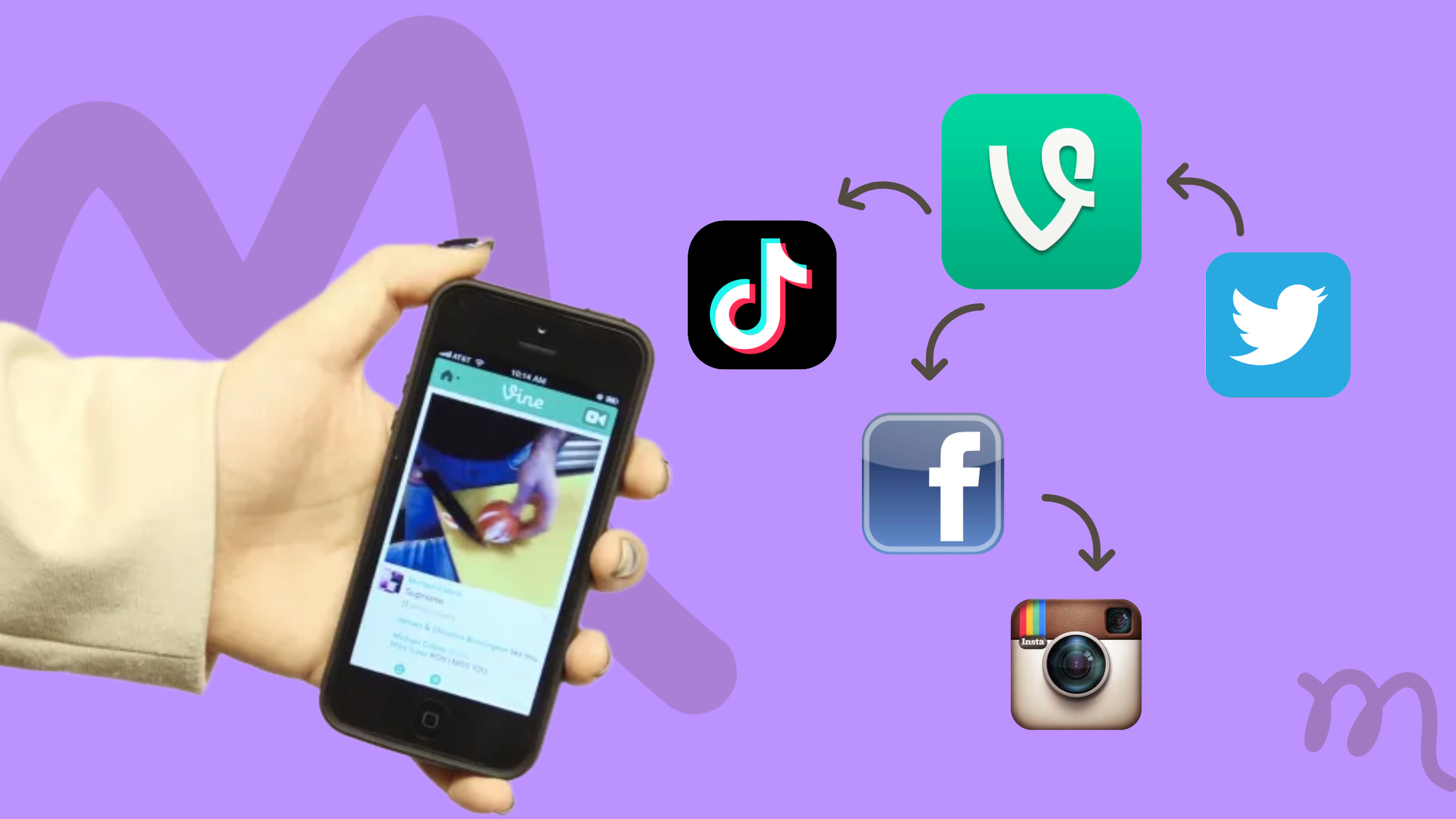
Do you remember when Vine got us all hooked on 6-sec videos?
Vine is the app that made uploading, creating, and viewing videos easy. The founders’ idea to solve the video uploading restraints of the times has changed the way we consume information forever.
Before Vine came along in 2012, video sharing required a lot of effort. At the time, uploading videos to Youtube and Facebook had multiple steps, took a long time to upload, especially on 3G, and compressed really badly. So the three founders, Dom Hofmann, Rus Yusupov, and Colin Kroll, wanted to solve this problem with an app that could make video creating frictionless, which could also compete with Facebook as a social network.
The Validation Work
The aim was to create an app that users can film, edit and share all in one place.
Initially, they didn’t plan for a 6.5-second limit, but the founders systematically tested time limits for the videos.
They tested:
- unlimited filming, which would mean taking up too much storage
- 1-second videos, which proved to be too short to convey an idea
- 30-second videos, which would take too long to upload via the mobile networks.
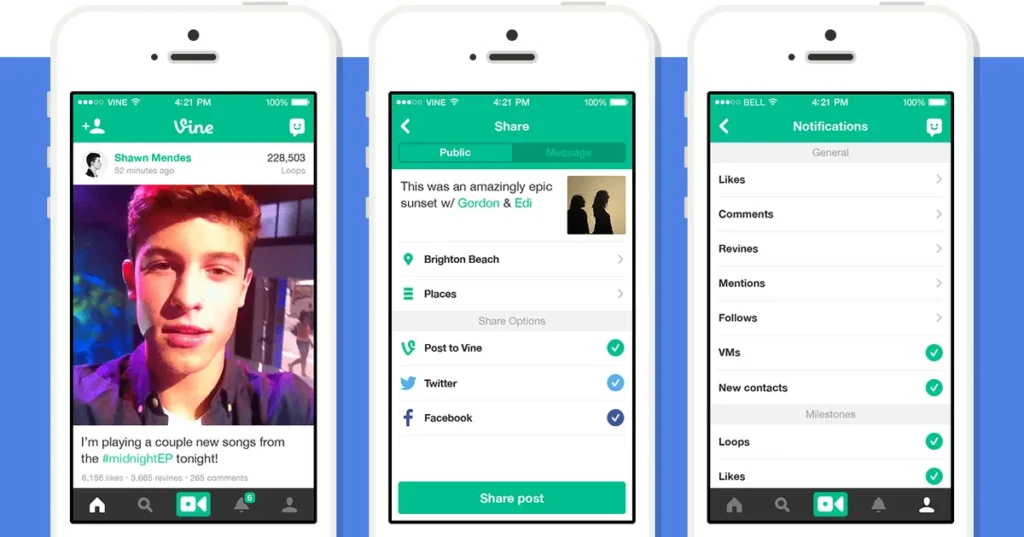
They finally settled on 6.5 seconds. They validated that this was long enough to capture an idea or create a narrative. They supported this decision by the “6-Second Rule” of advertising and initial decision-making. This traditional advertising theory claims 6 seconds is the ‘hook window’, as TV commercial directors and maker research firms’ studies showed viewer drop-off during the 30-second television spots.
Eye tracking and biometric research actually showed that if an ad failed to capture interest visually within the 5–6 seconds, viewers’ engagement dropped dramatically. This obviously led to the rule of introducing a conflict or a hook within 6 seconds.
“The absence of limitations is the enemy of art. You don’t just skip a six-second video, so you watch it.”
Dom Hoffmann.
So basically they eliminated the mental friction of pressing play, or more importantly, deciding whether a video is worth their time. Which I’m sure you’re familiar with now that we can view longer videos on social networks. I can’t be the only one who looks at the length of a video and decides whether it’s worth my time or not. With Vine, users were watching the videos before they could even make a judgment call.
Next thing they noticed was how the videos started and ended so quickly…
“The next thing that we noticed was that the videos start quickly but they also end very quickly and that felt anti-climactic,” Dom Hoffmann.
And so they decided to add a loop to the videos, which was another thing that gave content creators something else to be creative with.
MVP to Acquisition by Twitter
The MVP of Vine wasn’t even a social network with a feed; it was simply a camera utility app with a touch-to-record functionality. So the initial testing was all about whether this functionality felt natural to the users. However, during this testing and validation time, the founders observed that people recorded and shared the videos via SMS/iMessage’s. This was the biggest validation they could get to prove that this could turn into a social network. This could be the next viral content-creating app.
The validation process results were so compelling that when Twitter saw it, they acquired the company before the app even hit the App Store.
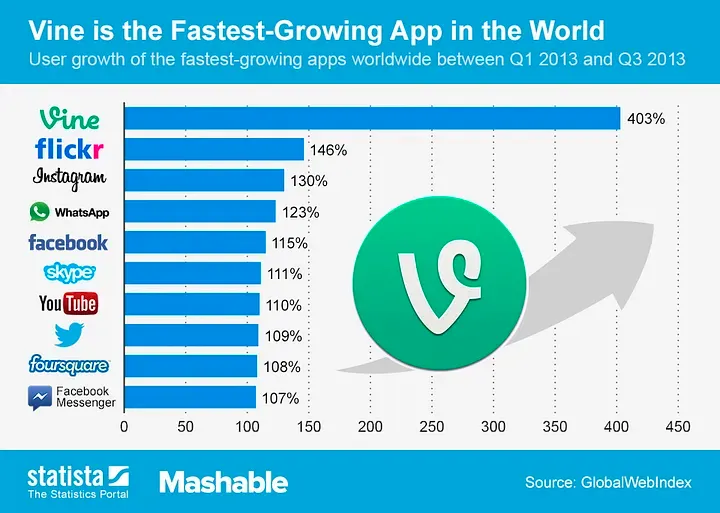
The app reached 13 million users in just 6 months and became the first runner for mobile video sharing and the fastest-growing app in the world (in 2013) leaving Flickr, Instagram, Facebook, YouTube, Twitter, Foursquare behind….
After 4 years in the market, they had 200 million followers.
The death of Vine despite its success
In 2016 Twitter announced that the Vine app would not be continued. Mind you, this is an app with 200 million active users at the time. Yes, it sounds confusing, but when you look at the facts, it is very clear why. The only thing that puzzles me is how the three founders, who were so strong at the validation phase, failed at the scaling-up phase. Let’s have a look at the reasons why:
1 – Lack of creator monetisation
Despite the popularity and high views, the creators had no way of monetising their work. They were having to send people to other networks from Vine to get any kind of revenue because platforms like YouTube were offering revenue via ads.
At the time, Instagram didn’t offer any native monetisation either; however, they had flexible formats that allowed opportunities for discount codes, sponsorships and links, whereas Vine creators were stuck with a six-second video option and nothing else.
An interesting thing happened in 2016 – a group of 18 Vine creators held a secret meeting with Twitter leadership, offering to stay and post 12 original Vines per month for a combined $1.2 million. Twitter rejected the idea; creators left the platform, which I guess gave Twitter all the more reason to shut it all down…
2 – Twitter’s interesting choices and financial struggles
Nonsensically, Twitter had also acquired Periscope right after Vine and even integrated it into the app to offer live streaming. This left Twitter with two products for which they did not have any strategy.
Moreover, Vine was a financial drain, costing millions of dollars every month on server costs, with – as you guessed – no way of making money. So Twitter, with its own financial struggles at the time, rather than improving the product, decided to cut it all off.
3 – Failing to innovate and improve in a competitive landscape
Vine not only ignored creators’ requests or needs to monetise; they also haven’t added a single new feature in the 4 years that they were popular. They ignored the user feedback, which is sad because their platform solely relied on the work of content creators. Meanwhile, Instagram launched 15-second videos with filters, which allowed people to vlog and tell stories. Snapchat started stealing Vine’s audience as they started offering stories and messaging.
By the time Vine tried to integrate these features, it was too late…
4- No Leadership and ownership
In 2014, all 3 founders left. Twitter, of course, delegated new leadership, but Twitter still didn’t have a strategy for what they were doing or how they were integrating Vine. So, with no clear direction, strategy, or ownership. Would Vine have become one of the dominant social network apps today if it had remained independent? Or if the directors had taken ownership and set boundaries with Twitter on the future roadmap of the product? Could it have grown to be one of the biggest income streams for creators if they had listened to their feedback?
We tend to remember Vine as a funny, nostalgic app that took over popular culture, but really what it did was introduce the habit of ‘scrolling through short videos’ that now all social networks are benefiting from. TikTok was pretty much born out of this idea, and then Reels was born to tap into the popularity of TikTok, Youtube Shorts followed, and so on… So while Vine was trying to speak to the human’s attention span, not knowingly, they introduced a behavioural shift. We are now a generation of people who sit down and scroll through videos to get our news, our entertainment, education, recipes and vlogs.
What is interesting is that we got into sharing and consuming videos so much that the products providing them had to increase the time limits. So now there is video content for all types of social content consumers.
Vine’s story definitely makes you think about the fact that a good idea is never the sole reason a product survives. Without a clear roadmap, feedback digestion strategy, and de-risking early on, even the best ideas can go to the start-up graveyard.
Disclaimer: This article is fully written by me, the human. I used an LLM only during research to gather resources and specific answers. Although I had quite a bit of back-and-forth with Gemini and Notebook for facts, the writing is solely mine. All grammar errors are my own and were not fed to an LLM for corrections; all resources are listed below.
Resources
- https://www.howtheygrow.co/p/why-vine-died-closing-the-loop-on
- https://medium.com/@vine/important-news-about-vine-909c5f4ae7a7
- https://www.youtube.com/watch?v=7C94MHnJMLA
- https://www.youtube.com/watch?v=NMo85axiuqc
- https://en.wikipedia.org/wiki/Vine_(service)
- https://www.failory.com/cemetery/vine

Leave a Reply